
Prison Officer profession
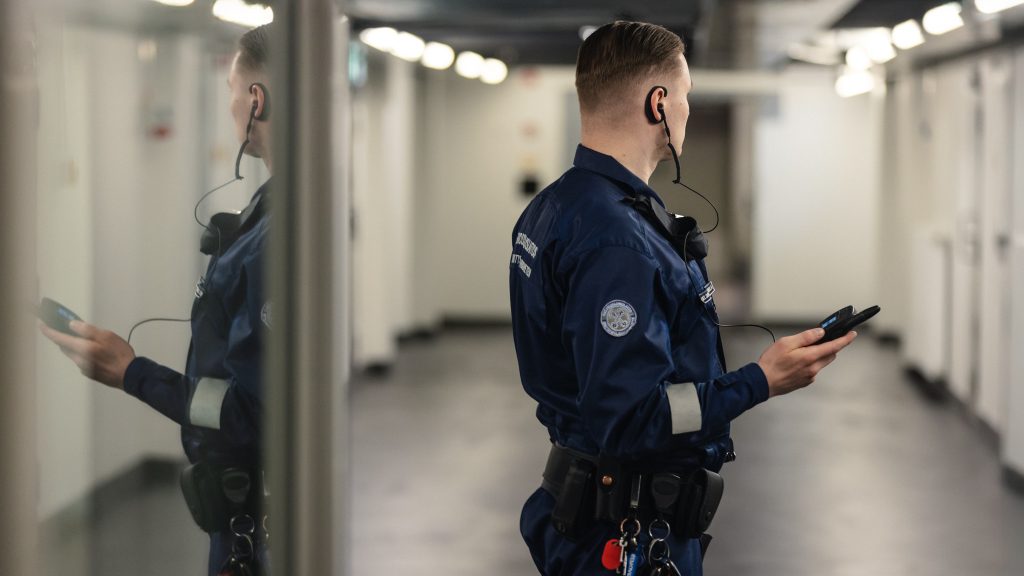
Prison officers ensure the safety of society, prison staff, and prisoners. They also take part in rehabilitation tasks, such as substance abuse work and organising prisoners’ free time activities.
Job description
Prison officers work in either a closed or an open prison. There are 28 prisons across Finland in total. The work is varied and emphasises interactive skills.
Employment prospects within the Prison and Probation Service are good because the work is essential and the duties are statutory. Prison officers are usually employed immediately after completing the qualification in prison and probation services.
The work of prison officers is strictly regulated. It is guided by legislation, regulations and instructions on imprisonment, as well as the values of the Prison and Probation Service:
- respect for human dignity
- justness
- safety and security
- belief in an individual’s potential to change and grow.
The profession requires knowledge of the operations and practices of the prison and probation services and, increasingly, the work of partners organisations.
Duties
The duties of prison officers may vary depending on the prison. Supervision is more intensive in closed prisons than in open prisons, where prisoners are allowed to leave the prison more freely, for example, to work or study.
Prison officers carry out the following duties, among others:
- Admit prisoners arriving at prison, introduce them to prison routines, and provide advice and guidance.
- Supervise prisoners continuously and round-the-clock, monitor their activities and guide them. The nature of supervision varies between prisons; naturally, there is less supervision in open prisons.
- Inspect prisoners and the facilities they use, such as accommodation wards and workshops, to find prohibited items and substances.
- Monitor meetings between the prisoners and their visitors.
- Escort prisoners outside the prison, for example, to court, hospital, or other events. For this reason, a driving licence is necessary.
- Guide authorities and visitors entering the prison.
- Use information technology for tasks such as supervision, information retrieval, and reporting.
Prison officers often work in shifts, so those entering the field must be prepared to work evenings, nights, and weekends. Working days are usually long, but there are several consecutive days off.
Prison officers may also act as personal officials, who guide and advise individual prisoners in accessing appropriate services and activities, and are thus responsible for goal-oriented work. Personal officials work in cooperation with, among others, senior instructors, instructors, work supervisors, study instructors, chaplains, psychologists, and social workers.
Prison officers can also specialise in different tasks, such as control room duties, security duties, dog handling, or prisoner transport.
Working in prison before training
Many people become interested in the prison and probation services and our training programme through summer work in a prison. You can enquire about fixed-term positions directly from the prison where you want to work.
Every year, prisons employ a large number of prison officers in fixed-term positions without a qualification in prison and probation services. It is possible to work as a fixed-term prison officer without training in the field for a maximum of two years.
Work experience gives you a better idea of what the job is like and whether it is suitable for you. Long prison work experience of at least seven months can be credited towards the qualification in prison and probation services.
Anyone working in a fixed-term position must be of legal age. Prison staff interview applicants and request their security clearance from the Finnish Security Intelligence Service. New employees are introduced to their duties at the prison.
How to apply?
You can enquire about job vacancies by email or by calling the head of prison or assistant director directly. You can find the contact information of the prisons on their individual web pages (rikosseuraamus.fi).
Prisons recruit fixed-term employees according to their own needs.